

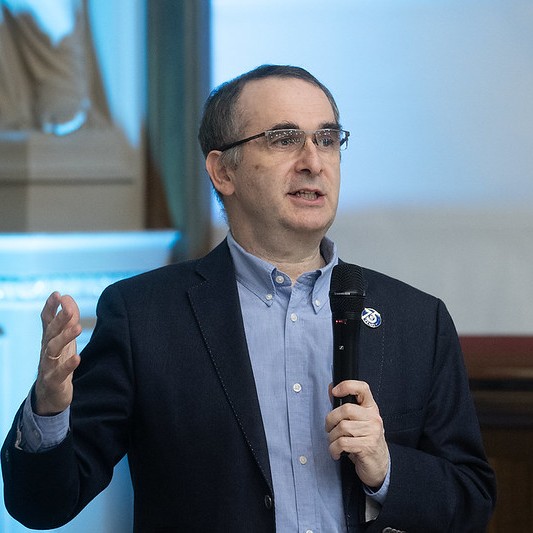
How can Hungary build a research system that rewards excellence, gives researchers a predictable future and encourages collaboration across disciplines? András Stipsicz, Member of the Hungarian Academy of Sciences, Director General of the Rényi Institute of Mathematics and incoming President of HUN-REN, addressed these questions in an interview on Kossuth Radio’s Felkelő programme (Morning Show). He outlined his vision for a modern research performance evaluation system, a renewed governance structure and stronger cooperation across the research network.
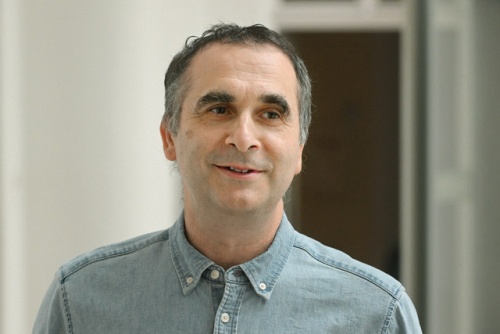 In response to a question from the interviewer, Stipsicz confirmed that the research network, which has undergone several transformations over the past eight years, currently operates as a non-profit private institution. The plan is for the research network to return to the Hungarian Academy of Sciences (MTA), but not in the same structural form in which it operated before its separation in 2019. Instead, it would adopt a modernised structure while retaining the progressive features of the current regulatory framework. “The new legislation on the research network is still taking shape, even as we speak, and is currently under professional consultation,” he added. The incoming HUN-REN president emphasised that funding for the network’s 15 institutes had improved significantly in recent years. Speaking about cohesion within the network, he highlighted the need to strike the right balance between institutional autonomy and cooperation. He recalled that, under the outgoing leadership, institute directors had felt that decision-making was becoming excessively centralised and had voiced their opposition to this.
“We hope that, with the help of the Hungarian Academy of Sciences and through our own efforts, we can find a structure that genuinely moves Hungarian science forward. Hungarian science needs to move forward in bigger leaps. (…) My task would be to ensure that we can sit down at the negotiating table and play an active role in making sure that the structure ultimately enshrined in law is one that also meets the needs of the research community. And we very much hope that this will help Hungarian science make further progress.”
A key element of the new legislation will be a restructuring of the research network’s governance. Under the current proposal, the Governing Board will be replaced by a Leadership Board, whose members will be delegated by the research network, the Hungarian Academy of Sciences and the Ministry of Science and Technology (TTM). This body will decide on the allocation of budgetary resources, much as the current Governing Board does, but "the way this body is formed will definitely change. For example, the Governing Board was entirely made up of people from outside the research community, with just one exception. Its members worked outside the network’s research community, and the network had no say whatsoever in who was appointed to the body,” Stipsicz continued. “Naturally, the ministry will also delegate members. This does not mean that the body will be subject to political influence. Rather, as the funding provider, the ministry will be able to express the priorities that the government considers important. I think that is perfectly reasonable.”
| The full interview given by András Stipsicz in Hungarian can be listened to HERE. The interview was made by the Hungarian National Public Radio by morning show host Erika Hatvani-Tóth. |
Asked about the state of research in Hungary, Stipsicz explained that, alongside appropriate financial recognition for researchers, the research environment is also of crucial importance. “A predictable and inspiring research environment is very important for researchers. A research career is full of uncertainty, and that uncertainty stems above all from the question each of us asks ourselves: is my own performance good enough? This is a productive kind of uncertainty. But it can only work well if we have confidence in the framework around us. We need to know what different levels of outstanding performance qualify us for and how they help us progress in our scientific careers. This is what has been missing from Hungary’s scientific community. We have gone through many changes, and very often these changes have been unpredictable. Too much uncertainty is no better than complete security. For researchers, it is very important to question their own performance and to be motivated to do better work.”
Stipsicz identified the development of a sustainable, well-balanced performance evaluation system for the long term as a top priority, adding that work on it would begin as early as the following week.
“There are highly simplified performance evaluation systems that take only one or two dimensions into account. For a large part of the research community, these are typically either irrelevant or simply disruptive. We will try to develop a much more nuanced and finely calibrated system.” The incoming president described the need to develop evaluation systems capable of assessing different scientific disciplines on a comparable basis, with all its difficulties, as a wider European challenge rather than a uniquely Hungarian quality. He recalled that Alfréd Rényi Institute of Mathematics had already developed a performance evaluation system covering different areas of mathematics. “From a distance, mathematics may seem like a very homogeneous discipline. But when you work within it, you see the different trends and directions, and we tried to bring these into alignment. The experience we gained from this may also help us harmonise the approaches used across broader scientific disciplines, and I hope we will succeed.”
Finally, the incoming president called for stronger collaboration between the institutes within the research network. “The tradition was for everyone to work independently, without any strong cohesion. This is something we definitely need to address. We have plans for encouraging researchers to learn the language of other disciplines first, and then understand their structures. This is a lengthy process, and it is only after achieving some initial successes that we can turn to external partners and ask them to support this collaboration. Until we reach those first milestones, I envisage that the network itself will need to provide support. That is part of our plan, too. (…) “To give an example from my own field, network science is an important part of mathematics. Brain research is conducted at another institute, and there is clearly a great deal the two fields could learn from each other. But this is not something that can be accomplished in a day or two. It requires a substantial investment of work, and I very much hope we will have the opportunity to make it happen.”